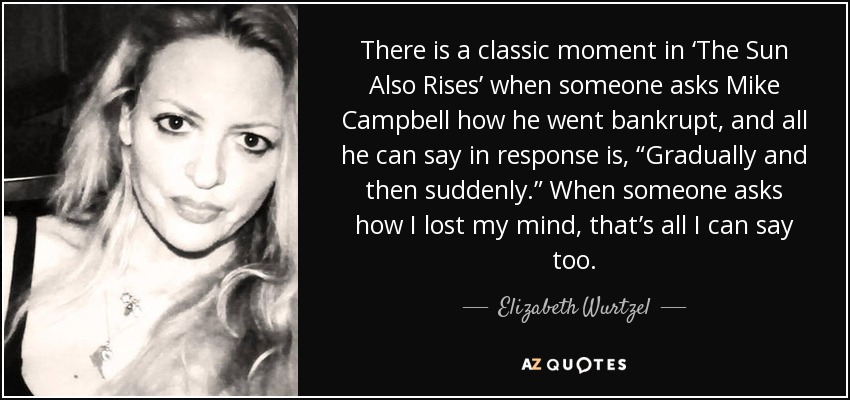
The World Wide Web went commercial - gradually, then suddenly.
A healthy ‘netstalgia’ dose (nostalgia for Ye Old Net) returns a cornucopia of pixelated GIFs, Flash Player browser games and textured backgrounds. Awash in excess excess, buying into the Before Internet is understandable. But the greatest tragedy has been hidden from us: this promise was never supposed to be kept. By trying to outrun our current dystopia, we’ve hallucinated a preceding utopia.
Let’s stop remembering and start redeveloping.
An acknowledgement: the zine you’re holding was written on a Google Doc. In 2024, Google was indicted by the U.S. Department of Justice to be a grade-A Monopolist, dominating the search engine trade and slurping up smaller companies with the manic zeal of a 13-year-old on Agar.io.
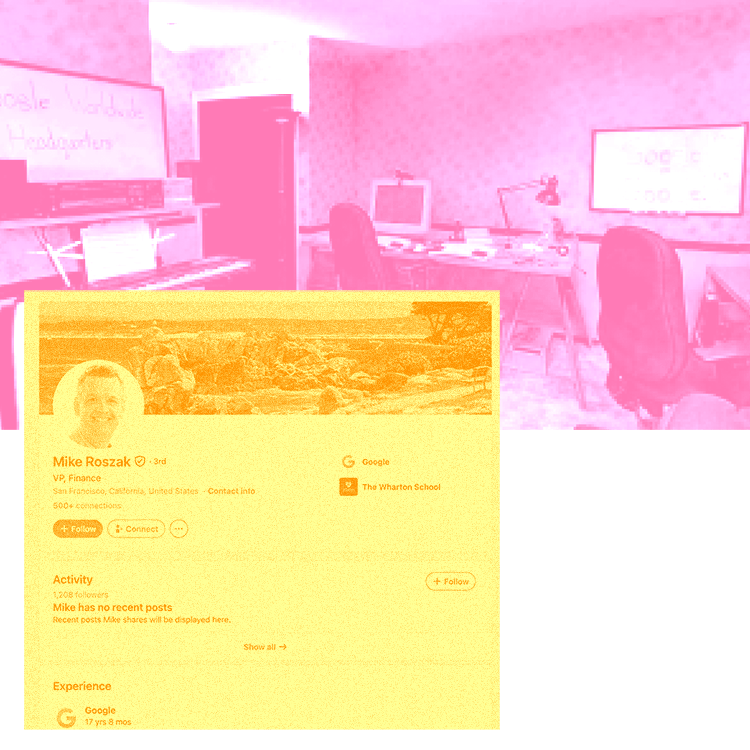
Says Michael Roszak (their VP of finance) in an court-released document: “search advertising is one of the world’s greatest business models…talking about revenue, we could mostly ignore the demand side (users and queries) and only focus on supply side of advertisers, ad formats, and sales”.
Meaning the world’s most-popular search engine cares less about searches than they do ads. Consider their latest and greatest mandatory feature, Google Gemini. Artificially-generated images push actual photographs far downstream, frontloading page results with unreliable summaries and bullet points about eating rocks. If one does venture past first scraps, any critical information might have been gleefully "named for removal" by political regimes playing interference.

Google’s productivity-to-profitability ruse is the rule, not the exception. It’s a massively popular tactic writer Cory Doctorow coined ‘enshittification’. AKA the simultaneous, shitty decline of all our digital services - just because it’s legal.
Both the companies and the billionaires who captain them are totally off-leash. A who’s who at Trump’s inauguration tells you everything: Mark Zuckerberg (Meta), Jeff Bezos (Amazon), Elon Musk (Tesla), Sundar Pichai (Google) haven’t gotten up off their knees since. Although other countries have introduced stricter anti-trust policies, America - where a majority of techbros veg out - hasn’t. That 2024 Google trial I mentioned? Up until then, Big Tech hadn’t seen a suit since the early 1990s. Specifically, 1998: when Blockbuster had been a booming, national chain. Although a wide-scale crackdown is receiving bipartisan support, the potential retribution is negligible. When John Deere prevents its customers from performing home repairs and remotely deactivates tractors at a finger snap, America barely blinks. So, what should we do?
#goingoffline is a major movement. Ironically, a movement spreading fast through viral videos that dole out advice on avoiding the Internet. The Luddite Club, taking their name from 19th-century fabric workers, currently has chapters all across America. First a friend group and now nearly a non-profit, The Club is an exceptional example of active mobilization. They publish a print-only newsletter and host weekly meetings where attendees read together, no blue light necessary. Another notable non-profit is The Strother School of Radical Attention. By teaching ‘radical attention’ tactics, the organization helps fortify against digital addiction and doom-scrolling.
If you’re feeling up to amputation, this might be the best option. #goingoffline doesn’t have to happen cold turkey; take the digital detox slowly, and healthier habits will replace the harmful ones. Chose one day a week to ignore your phone. House chargers in your kitchen rather than your bedroom. Explore material hobbies like crochet and collage, or physical ones like running and yoga. Move your body enough to remember you have one. A clean cutoff might be impossible, but this reality doesn’t negate intentionality. Rethinking the technology we rely on mentally cleaves us from the machine. Stepping back can be a breath of fresh air.
Ultimately, our digital lives are here to stay. I don’t mean roll over and play dead. I mean a major part of taking agency is Taking Back the Net. Our parasitic relationship was/is not inevitable, merely profitable. A plastic bag can carry or choke, depending on the hand holding it. I can’t help loving the Internet. So our second option, rather than fantasize a make-believe net, is to actually make that net.
There are tiny imps who live inside your bank account and siphon money, post your private information, sell your data. Contrary to popular belief, imps are not the only ‘hackers’ allowed. Although a basement dweller might tell you otherwise, my personal belief is that anyone can be a hacker. That is - anyone can reshape their computer, should they become unsatisfied. Anyone can reshape their culture, should they recognize shortcomings.
‘Hacktivists’(hacker activists) are a primary example. Think Wikileaks, an open-source publisher of otherwise restricted information. The platform burst into the scene in 2010 when activist/former army private Chelsea Manning released classified internal documents regarding civilian deaths in Iraq and Afghanistan. Turns out, the U.S. military had covered up more than 15,000 casualties and conveniently forgot about all the severe human rights violations being committed against POWs. She was sentenced to 35 years in federal prison. Thankfully, a now free Manning moonlights as a democratic socialist DJ. Such gratuitous punishment is typical in cases of ‘espionage’. Hacktivists are severely punished by their offending governments for promoting basic informational transparency.
I’m not asking you to enter the mainframe and release the Epstein files. Once upon a time, anyone could be a programmer. Go back even further, anyone could be a computer. Code used to be published line-by-line in popular magazines for home-users to plug in and play with independently. Building a rudimentary browser game meant a few afternoons at the local library. Modern monopolies have become gatekeepers to systems we should know. So, accessible hacktivism; a doorway open for everyone, regardless of education or experience. Academic Chaim Gingold refers to these tools as ‘magic crayons’ - methods for non-programmers to create dynamic, digital worlds.
Hacktivism could be as natural as ‘glitching out’. Like: 50 Californians ordering Waymos en masse to confuse the self-driving cars into hours of circling blocks and honking endlessly at each other. Waymo, a subsidiary of Google, has been a constant source of eyesores and noise pollution for Los Angeles since their introduction last year. Rather than commit arson, as has been wont to happen, hacktivists decided to break the software. The premise is silly, meaning it has substance. Hacktivists call this denial-of-service (DoS): overloading the system until it gives, a sit-in through simple code and site traffic.
Classic, unadulterated activism works well too. Protesting local data center construction has successfully stopped builds in Virginia, Pennsylvania and North Carolina. If allowed to infiltrate, companies offload higher electricity costs onto the community. Paying for your data to be categorized and contained, for your water to be guzzled and muddied, doesn’t sound like the future. It sounds like subordination. #TeslaTakedown, a national campaign to protest CEO Elon Musk’s anti-democratic ambitions, has caused company stock to plummet. Social shaming has caused Tesla owners such humiliation that adding an ‘Anti-Elon’ bumper sticker is practically required to continue driving their highly flammable car cysts.
Finally, put your money where your mouth and mind are. Reconsider the applications you consider essential: are there alternatives? Can you watch cat videos without cutting years off your life? Circumvent listening algorithms like Spotify by purchasing tracks directly or seeking intentionally. Club Carter Radio is one of many independent DJs and artists who advocate for aux control. Backup critical files on your computer harddrive - not cloud - to ensure permanence. Use a search engine that doesn’t track your data or enforce artificial responses. Personally, I use Librewolf.
Take advantage of our information networks and begin learning basic programming. Sites like GitHub and OSP Kitchen are havens for open-source code. These are the digital equivalents to past magazines publishing free, malleable programs, and their communities are glad for newbies/non-programmers. Neocities is a free webhost that empowers users to build personal static sites, freely expressing their online selves without the aesthetic and atmospheric restrictions of mainstream social media. (Neocities is the platform I’ve published this zine on! How very meta). Majority of these changes are inconvenient and uncomfortable, I know. They take time and thought, valuable resources you might feel better directed towards something else. But our virtual and physical lives are permanently intertwined, for better or worse. The Internet has installed itself everywhere: store kiosks, dashboards, eyeglasses, kitchen appliances, showerheads. Still - it’s not too late to think things through.